
In 2025, over 80% of organizations use AI to detect errors or bias in their automated systems, which leads to costly mistakes, reputational risks, and compliance challenges.
So now imagine an AI system flags a critical health condition, but misinterpreting subtle nuances, without human oversight, the consequences could be dire. This is where the human in the loop becomes indispensable. By implanting human judgment directly into AI workflows, organizations make sure that each decision is refined and aligned with real-world context.
Human in the loop AI isn’t just a safety measure; it is a strategic enabler for AI services, allowing systems to learn continuously from human feedback, adapt to changing environments, and reduce errors over time.
From healthcare diagnostics and content moderation to cybersecurity and customer support, the hybrid approach combines the speed and scalability of AI with the critical reasoning, ethics, and oversight that only humans can provide.
In the sections that follow, we will explore what is human in the loop, how it works, the benefits, the challenges, and the best practices for building trustworthy AI systems.
What Is “Human in the Loop”?
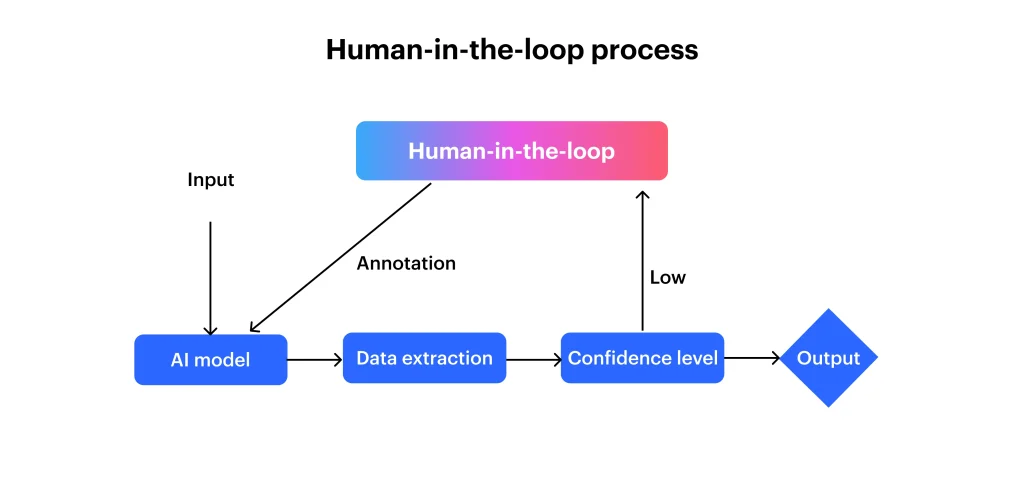
As AI systems grow more powerful, they are still capable of making errors, biases, and misinterpretations, especially in complex or ambiguous situations. So, what is human in the loop?
Simply put, it is the integration of human judgment into AI workflows, making sure that critical decisions are guided, corrected, or approved by humans.
Definition & core idea: Human-in-the-loop refers to the process where AI systems don’t operate fully autonomously. Humans actively participate in reviewing outputs, validating predictions, and giving feedback to better the system. For example, a medical AI may suggest a diagnosis, but a doctor confirms it before finalizing.
Variants & interaction modes: Humans can be involved during training, such as labeling data, and also during inference, like reviewing AI outputs, as well as in continuous learning loops, where they correct AI predictions over time.
Why is this coupling needed? AI models mostly face edge cases, rare scenarios, or context-specific challenges they weren’t trained on. As with human direction, it gives accuracy, ethical alignment, and real-world reliability, making AI decisions trustworthy and effective.
Why Human in the Loop is Essential for AI Systems
AI might be a fast and data-driven technology, but without human oversight, it can easily misinterpret context, miss nuances, or reinforce bias. Understanding human-in-the-loop helps to clarify why human involvement is important for dependable and responsible AI outcomes.
Improving Accuracy and Reducing Errors
Humans act as the quality controllers in the process, spotting anomalies, validating predictions, and refining results. For instance, in LLM fine-tuning, human reviewers evaluate and correct the model outputs and improve overall accuracy.
Ethical Considerations and Bias Mitigation
Human judgment guarantees fairness and moral responsibility. By detecting the prejudiced data patterns, humans prevent AI from making biased or harmful decisions.
Real-time Adaptation and Flexibility
Contrary to rigid AI algorithms, humans apply intuition and contextual understanding to handle unpredictable scenarios. This dynamic collaboration between people and machines allows human in the loop AI systems to stay adaptable, ethical, and consistently align with real-world needs.
Building on its vital role in ensuring accuracy and ethics, Human-in-the-Loop (HITL) also plays a pivotal part in shaping how AI systems are trained and refined for real-world performance.
How HITL Impacts AI Model Development
The human in the loop meaning extends beyond oversight; it involves active collaboration at every stage of AI model development.
Training AI Models: Human label datasets, review outputs, and give corrective feedback. The continuous feedback loop helps AI understand context, tone, and intent, which raw data alone cannot convey, and is essential for reliable model learning.
Fine-tuning AI systems: After initial training, humans assess AI predictions, correct inaccuracies, and guide iterative improvements. This whole process ensures human-in-the-loop systems change with better precision, fairness, and adaptability, building models that not only learn from data but from human experience itself.
The Real-World Advantages of Human-in-the-Loop Systems
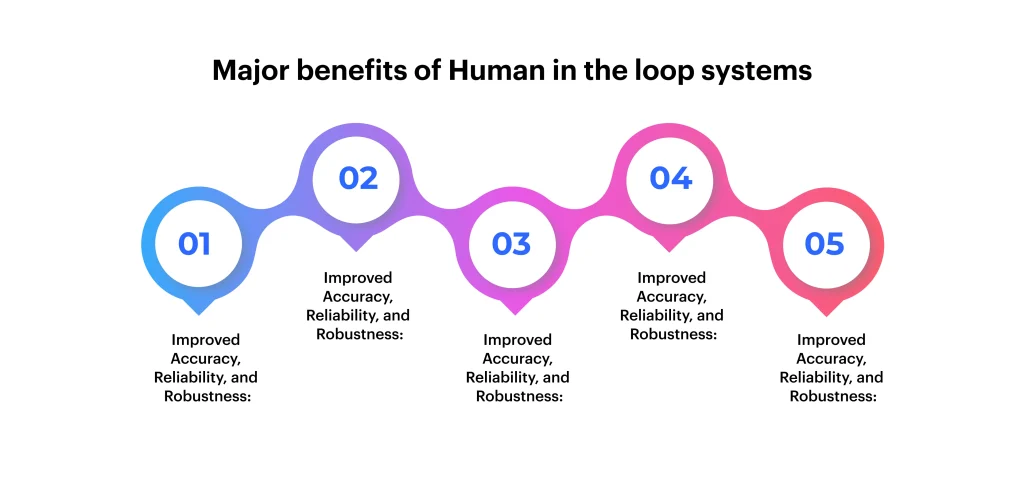
In the current changing AI landscape, true intelligence emerges where humans’ intuition meets machines’ precision. The integrating human in the loop doesn’t just improve outcomes; it drastically transforms how systems think, learn, and evolve across all industries, from healthcare to AI chatbot development services.
1. Improved Accuracy, Reliability, and Robustness:
Human validations confirm models make fewer mistakes, strengthening performance even in unpredictable environments.
2. Bias Mitigation, Fairness, and Ethical Alignment:
Humans give cultural awareness and moral reasoning, which help AI to make balanced, responsible decisions.
3. Transparency, Explainability, and Trust:
With human oversight, AI systems become more interpretable, where users can understand how and why decisions are made.
4. Efficiency: Hybrid Scalability:
The correct blend of automation and human input makes scalable workflows without sacrificing quality or speed.
5. Adaptability, Learning, and Co-evolution:
The continuous feedback from humans enables AI to change dynamically, adapting to new data, contexts, and user behaviors for long-term relevance.
The Hidden Challenges Behind Human-in-the-Loop Systems
While human in the loop AI drives precision and accountability, it also introduces unique challenges that can impact efficiency and scalability. It strikes the right balance between automation and human oversight, which is crucial for sustainable, high-performing AI systems.
Cost, Resource & Latency Overhead:
Integrating humans increases operational costs and can slow down decision-making, mainly in real-time applications.
Scalability Constraints:
As data and model complexity grow, maintaining human participation becomes tough without automation support.
Human Biases, Errors, and Consistency Issues:
Humans can unintentionally give biases or make inconsistent judgments, affecting AI outcomes.
Workflow Complexity & Design Difficulty:
Designing easy workflows between AI models and human reviewers needs sophisticated coordination and user-friendly interfaces.
Dependency Risk & Human-in-the-Loop Becoming a Crutch:
Over-reliance on humans might limit the AI’s autonomy and hinder its ability to learn and adapt independently.
Despite these trade-offs, humans in the loop are indispensable for creating responsible and trustworthy AI.
Understanding the Difference: Human-in-the-Loop vs Human-on-the-Loop
As AI systems develop toward greater autonomy, the way humans interact with them defines their reliability and control.
The comparison of human in the loop vs human on the loop highlights two distinct collaboration models: one where humans directly guide decisions and another where they oversee outcomes from a supervisory level.
Aspect | Human-in-the-Loop (HITL) | Human-on-the-Loop (HOTL) |
|---|---|---|
Definition | Humans are actively involved in the AI decision or learning process — they review, approve, or correct AI outputs before final action is taken. | Humans monitor AI systems externally and intervene only when necessary or when anomalies occur. |
Interaction Timing | Occurs in real time or iteratively during training, validation, or inference. | Occurs post-decision or at the supervisory level, often using dashboards or alerts. |
Control Level | Direct human control — AI decisions depend on human confirmation or input. | Indirect oversight — AI operates autonomously, but humans can override or audit. |
Use Cases | Data labeling, model validation, healthcare diagnostics, and content moderation. | Autonomous vehicles, cybersecurity systems, financial trading bots, and large-scale monitoring tools. |
Advantages | Ensures high accuracy, reduces bias, and provides ethical oversight in critical tasks. | Enables scalability, continuous monitoring, and faster system operation with safety backstops. |
Limitations | Increases cost and latency; less scalable. | Risk of “automation bias” or delayed human response in emergencies. |
In human-in-the-loop systems, humans are primarily embedded in the AI’s decision-making or learning cycles. They actively review, validate, or correct outputs, ensuring accuracy and ethical compliance. This approach is common in sensitive applications like healthcare, data labeling, and content moderation, where mistakes can have serious consequences.
In contrast, human-on-the-loop systems emphasize oversight rather than direct intervention. Humans supervise AI processes, stepping in only when anomalies, risks, or ethical concerns arise. The model offers greater scalability but relies heavily on trust in the systems’ autonomous and response mechanisms.
Best Practices: Building Smarter Human in the Loop Systems
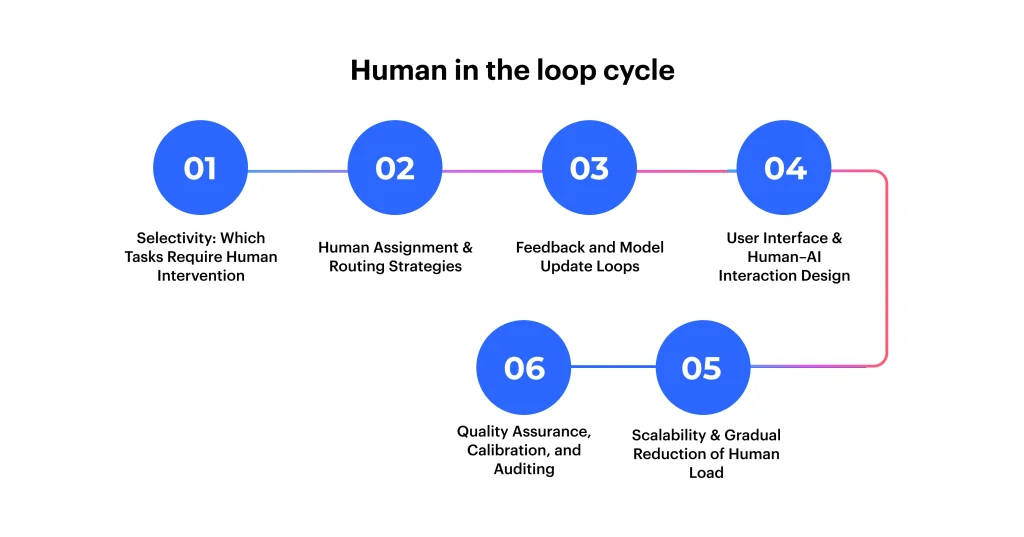
Designing an effective human in the loop AI system requires more than just inserting humans into the process; it is about striking a balance between human expertise and machine efficiency. The goal is to build adaptive, reliable, and scalable AI solutions that continuously learn and improve through collaboration.
Selectivity: Which Tasks Require Human Intervention
Identify critical decision points in which human judgment adds value, like ethical reviews, anomaly detection, or sensitive data labeling.
Human Assignment & Routing Strategies:
Match the tasks to humans based on expertise, workload, and context to maintain efficiency and reduce cognitive fatigue.
Feedback and Model Update Loops:
Establish a strong, structured feedback channel so that human inputs can directly inform future model training and behavior.
User Interface & Human–AI Interaction Design:
Build an intuitive interfaces that make it easy for humans to review, approve, and correct AI outputs quickly.
Quality Assurance, Calibration, and Auditing:
Continuously monitor performance metrics to provide human reviewers with a means to maintain consistency and accuracy.
Scalability & Gradual Reduction of Human Load:
As AI matures, it progressively reduces human dependence while preserving oversight in critical operations.
Real-World Applications of Human in the Loop Systems
From everyday digital interactions to mission-critical industries, human in the loop play an important role in making sure AI systems remain accurate, ethical, and human-aligned. Here are some key real-world examples:
Medical / Healthcare Diagnostics: Doctors validate AI-generated predictions to ensure reliable and safe patient outcomes.
Content Moderation & Safety: Humans review flagged content to maintain platform safety and cultural sensitivity.
Autonomous Vehicles / Robotics: Operators monitor and intervene in uncertain or high-risk driving or navigation scenarios.
Customer Support & Generative AI / Chatbots: Agents refine chatbot responses for empathy, tone, and accuracy.
Security / Threat Detection / Cybersecurity: Experts analyze alerts generated by AI to verify and prioritize potential threats.
Empathy / Support Systems: Human oversight ensures emotional intelligence in AI-driven mental health tools.
Data Labeling / Annotation Platforms: Annotators train and refine datasets, enhancing AI learning accuracy.
The Future of HITL: Evolving Roles and Emerging Trends
As AI systems grow more advanced, the human-in-the-loop approach is shifting toward a model of dynamic autonomy and trust calibration. The future AI will handle repetitive tasks independently while humans intervene in complex, high-risk, or context-driven scenarios. This balance will enhance reliability and make sure systems operate safely and transparently.
At the same time, hybrid or reciprocal learning models will allow humans and AI to learn from each other continuously, improving accuracy and adaptability across applications like data annotation services, automation, and credit analytics.
Additionally, the next wave of AI evolution will focus on intuitive human-AI interfaces, smarter trigger mechanisms for intervention, and increased explainability. As global regulations and ethical standards tighten, AI systems will be required to demonstrate accountability, fairness, and human alignment, ensuring that technology remains not just intelligent but also responsible and trustworthy.
Sum Up: The Power and Promise of Human-in-the-Loop
The human in the loop approach ensures that the AI system remains accurate, ethical, and adaptable by combining human judgment with machine intelligence. From model training to real-time decision making, this balance is what keeps innovation grounded in trust and responsibility.
As AI grows more powerful, the need for humans in the loop becomes more crucial to guide, validate, and humanize automation.
At Openxcell, we help organizations embrace the balance through our advanced Gen AI services, automation, data-driven solutions, AI consulting, etc, to make your systems both smart and accountable.