

In this day and age, AI is no longer confined to big IT companies or labs; it is part of our daily lives, from chatbots that resolve queries in seconds to autonomous systems that steer cars on busy streets.
A McKinsey report suggests that AI adoption could contribute up to $4.4 trillion annually to the global economy, with a significant share driven by intelligent types of AI agents that automate complex decisions.
Key Takeaways on Types of AI Agents |
|---|
As organizations race to integrate AI development services into their operations, the spotlight is on understanding various types of AI agents. From rule-based reflex models to adaptive learning agents, these intelligent systems are shaping industries, transforming efficiency, and unlocking new possibilities for innovation. But first, let’s learn about AI agents.
What is an AI Agent?
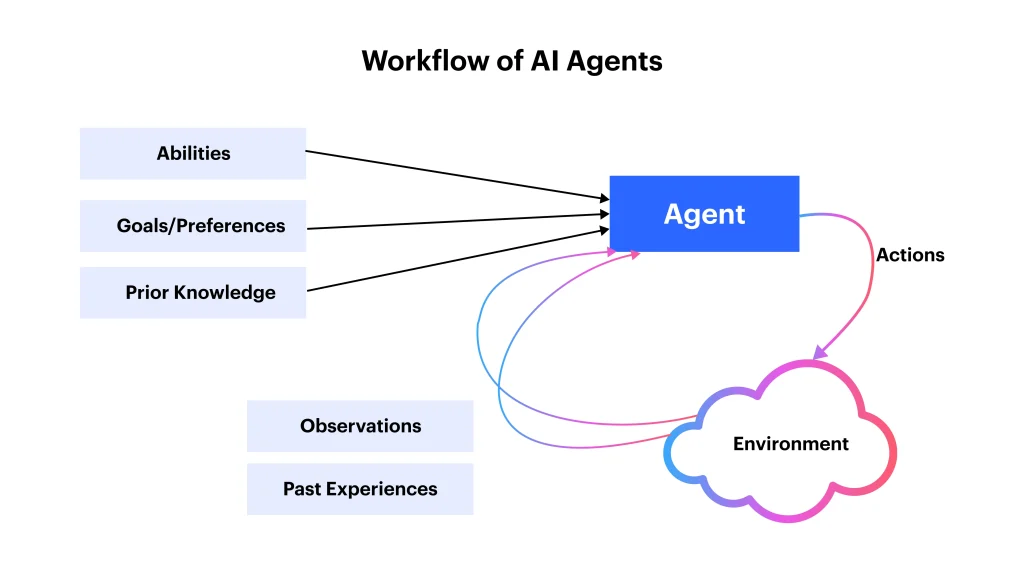
An AI agent is an intelligent software entity that perceives its environment, processes information, and takes actions to achieve specific goals with minimal human intervention. Unlike traditional programs that follow strict instructions, AI agents adapt and respond dynamically based on data inputs.
For example, voice assistants like Alexa or autonomous cars are AI agents that sense their surroundings, interpret data, and act accordingly to provide great experiences. AI agents can range from simple reactive systems to highly advanced learning models, making them a core part of various AI agent types.
With the rise of tailored AI agent development services, organizations can now design agents that can easily automate workflows, enhance decision-making, and provide personalized user experiences across industries.
Key Characteristics:
Autonomy & Decision-Making: AI agents work independently, making choices by themselves without constant human involvement.
Perception & Reasoning: They interpret data from the environment and their surroundings using logical reasoning to decide their next action.
Goal-driven Behavior: Every action of the AI agent is directed toward achieving a predefined objective or solving a specific problem.
Adaptability & Learning: Advanced agents continuously learn from past experiences and refine their performance over time
Exploring Types of AI Agents
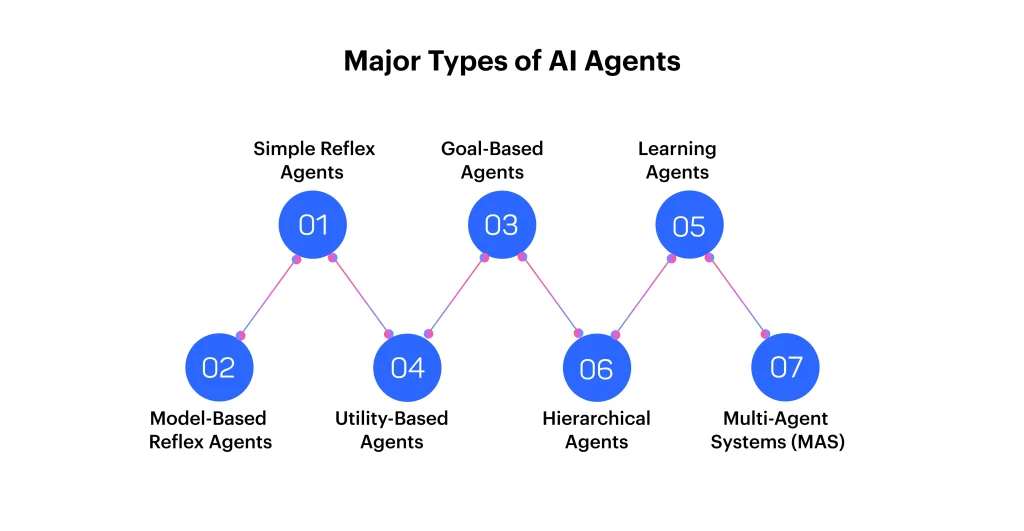
After understanding what AI agents are, it comes to building intelligent systems. There are different types of AI agents, from the foundation for how machines perceive, decide, and act.
These agents vary in complexity, from basic rule-based systems to advanced multi-agent frameworks that can collaborate on complex tasks. Understanding these classic types of AI agents is important to grasp how they evolved from simple automation to adaptive intelligence.
1. Simple Reflex Agents
Simple reflex agents act purely on the basis of current inputs, without any memory of past data or events. The agent follows the “if condition, then action” rule, making it fast and efficient in difficult environments. However, it struggles when the condition changes or when decisions require history.
React instantly to stimuli without storing information.
Suitable for repetitive and static tasks like thermostats or automatic doors that open when sensors detect motion.
2. Model-Based Reflex Agents
Unlike simple reflex agents, model-based reflex agents maintain an internal model of the environment. This allows them to handle partially observable situations where past data influences current decisions. Their internal memory helps them adapt better to dynamic conditions.
Use a stored model to interpret incomplete information.
Applied in self-driving cars (Tesla Autopilot) that need to remember lane positions, obstacles, and prior movements.
3. Goal-Based Agents
Goal-based agents are driven by defined goals and select actions that bring them closer to achieving those objectives. The agent compares possible outcomes and chooses the most effective path, making it more flexible than reflex-based models.
Evaluate multiple choices based on goal achievement.
Common in Google Maps or Waze, which analyzes routes to reach a destination efficiently.
4. Utility-Based Agents
These agents consider not only whether a goal is achieved but also how desirable the outcome is. They see a utility function to measure success, balancing trade-offs between competing options for optimal results.
Maximize overall satisfaction or performance.
Found in Netflix or Spotify recommendation engines, which balance accuracy, personalization, and user satisfaction.
5. Learning Agents
Learning agents improve performance by learning from past events and refining actions. The agent typically consists of components like a critic for feedback and a learning element for improvement. Over time, they become more accurate and efficient.
Continuously adapt and optimize based on feedback.
Examples include fraud detection systems in banking (PayPal) and spam filters in Gmail.
6. Hierarchical Agents
The agents break down complex problems into multiple levels, where big layers handle planning and low layers execute actions. This structured approach makes it highly effective in managing large-scale or multi-step processes.
Divide tasks into logical layers of decision-making.
Useful in industrial robotics (like ABB or FANUC systems), where robots plan tasks at one level and execute precise movements at another.
7. Multi-Agent Systems (MAS)
MAS consists of multiple agents who collaborate or compete in a shared environment. They are especially powerful in solving problems that are complex for one agent, as they combine different skills and perspectives.
Enable distributed intelligence through cooperation or competition.
Applied in air traffic control systems, Amazon’s warehouse robots, and multiplayer online games where agents interact in real time.
Related Read: Agentic vs Generative AI: Which One Fits Your Needs?
Beyond the basics, AI agents are now evolving into extended, modern categories that push their capabilities further.
Extended & Modern Agent Categories
As AI is changing, new forms of agents are coming that go beyond traditional definitions. These extended and modern categories give more intelligence, adaptability, and human-like interaction to real-world apps. They define the future of automation, decision-making, and problem-solving in business and everyday life.
Conversational Agents
These AI agents are built to hold natural, human-like conversations. They power chatbots, customer support systems, and voice assistants by understanding queries, generating responses, and improving user interactions. When deployed as White label AI Agents, they allow businesses to offer real-time engagement under their own brand, making them widely used across industries such as business services, healthcare, and personal assistance.
Planning Agents
Planning agents focus on analyzing situations, creating step-by-step strategies, and setting goals to achieve them. They can adapt to changing conditions, making them useful for project management, logistics, and complex problem-solving. Unlike simple rule-based systems, they consider multiple pathways before deciding on the most efficient one.
Multimodal Agents
Multimodal agents process and combine different types of input, like text, speech, images, and video, to provide richer outputs. For example, it can read text, analyze a picture, and respond with context-aware answers. These are especially important for AI agentic workflows where tasks demand a proper understanding of information in multiple formats.
Embodied Agents
These agents exist in physical or virtual bodies, such as avatars, robots, or simulation characters. These agents interact with environments, make decisions, and sometimes even show gestures or emotions. These agents are suitable for robotics, gaming, training simulations, and real-world assistance.
Virtual Assistants
Virtual assistants are designed to perform tasks on behalf of users, like sending reminders, scheduling meetings, or managing information. For example, Siri, Alexa, and Google Assistant act as one’s personalized digital companions, improving productivity and simplifying daily routines.
Buyer / Monitoring Agents
These agents autonomously scan markets, monitor prices, and track trends to help users make better buying decisions. Businesses use them for competitive intelligence, while consumers use them for finding the best deals. They represent one of the most practical examples among the different types of agents in AI, as they directly impact decision-making and cost efficiency.
AI Agents at Work: Examples & Applications
AI agents are no longer restricted to research teams; they are changing enterprises and everyday applications. By exploring the types of AI agents with examples, we can see how they deliver real-world impact across industries.
From Research & Enterprises
AI agents in research and enterprise are used for data analysis, decision support, and automation. For example, conversational agents strengthen customer service, planning agents streamline supply chains, and monitoring agents track financial risks. These types of AI agents give organizations the ability to achieve scale and efficiency.
Emerging Applications
In emerging fields, AI agents are applied to industries like healthcare diagnostics, robotics, personalized learning, and smart assistants. Multimodal agents, part of advanced types of AI agents, integrate text, voice, and images to provide smooth interactions. These innovations show how an agentic system adapts to complex, real-world scenarios.
Type of AI Agent | Description | Real-World Example |
|---|---|---|
Simple Reflex Agents | Respond directly to stimuli using predefined rules. | Spam filters in email services |
Model-Based Agents | Use memory of past actions to make better decisions. | Self-driving cars (Tesla Autopilot) |
Goal-Based Agents | Make decisions aligned with specific goals. | Google Maps route optimization |
Utility-Based Agents | Evaluate outcomes and choose the most efficient option. | E-commerce recommendation engines |
Learning Agents | Continuously learn and adapt to improve performance. | ChatGPT & similar conversational AI |
Embodied Agents | Agents interacting in physical or virtual environments. | Robots, AR/VR avatars |
Also Learn: How to Build an AI Agent - Step By Step
The Upsides and Downsides of AI Agents
As we explore different AI agent types, it is essential to understand not just their amazing benefits but also the challenges that come with implementation. Businesses and researchers must balance efficiency and innovation with responsibility and reliability.
Benefits of AI Agents
AI agents are transforming how any system learns, collaborates, and adapts. There are tons of advantages that extend across industries, from driving performance gains to delivering more personalized experiences.
Efficiency & Productivity Boost – By combining Agentic RAG with autonomous decision making, AI agents streamline workflows and cut down repetitive tasks, adding faster and more accurate outcomes.
Scalability – AI agents handle increasing workloads effortlessly, allowing businesses to scale operations with proportional increases in human effort.
Learning & Personalization – With continuous learning, agents adapt to users’ preferences and behavior, giving them tailored solutions and improving over time.
Collaborative Potential – AI agents can easily integrate with all systems and human teams, providing collaboration that enhances efficiency and innovation.
Challenges of AI Agents
Despite their strong potential, AI agents still face hurdles that can limit their adoption. Addressing these issues is important for sustainable and ethical growth.
Computational Cost -Running advanced AI models demands a lot of processing power, raising concerns over infrastructure costs.
Reliability & Hallucination – AI agents may give incorrect or fabricated responses, undermining trust in critical applications.
Integration Complexity – Adding AI agents into an existing system mostly needs significant technical effort and restructuring.
Ethical & Business Uncertainty – Questions around data privacy, accountability, and impact on jobs give risks that organizations must navigate carefully.
Wrapping Up the AI Agent Landscape
AI agents are reshaping the future of technology by automating tasks, making intelligent decisions, and personalizing user experiences. From autonomous systems to learning based models, the different types of AI agents are providing efficiency, scalability, and collaboration across industries.
By exploring the types of AI agents with examples, businesses can better understand their advantages and limitations and how to strategically implement them for maximum impact. At Openxcell, we empower organizations to work with confidence in AI innovation. Our expertise in AI strategy, Gen AI, and enterprise-ready solutions helps clients to easily integrate intelligent agents and unlock real business value.